
Best River Rock Size For A Dry Creek Bed
Best River Rock Size For A Dry Creek Bed
A dry creek bed should look as though water could have shaped it, even when the Arizona sky has been clear for weeks. Using one uniform layer of small stone often produces something closer to a gravel stripe than a natural channel.
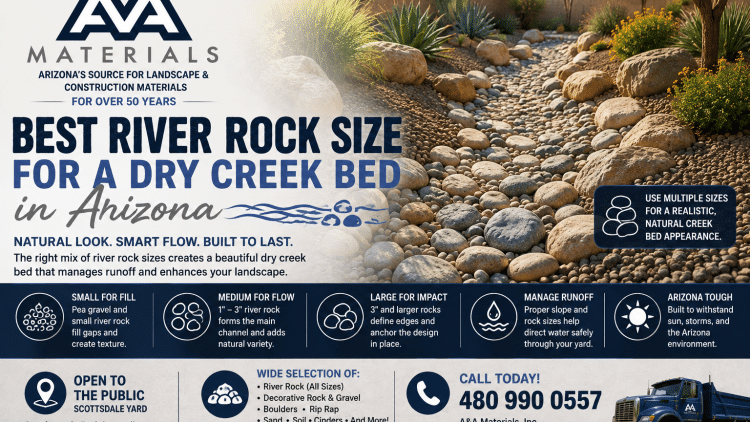
Choosing the best river rock size for a dry creek bed depends on the width of the feature, the amount of runoff, the slope, and whether the project is mainly decorative or expected to carry water. A convincing result usually uses more than one size.
Begin With The Purpose Of The Creek Bed
A decorative creek bed can guide the eye through a xeriscape, soften a long wall, or connect boulders and planting areas. A working drainage channel has another responsibility. It must receive runoff and move or retain it without sending water toward the house, pool, street, or neighboring property.
Follow the existing drainage pattern rather than creating a new one based only on appearance. The City of Scottsdale advises homeowners to preserve the capacity of designed retention areas and drainage features during landscaping changes.
When the site has repeated flooding, erosion near a structure, or a steep flow path, seek professional guidance. River rock can protect a prepared channel, but it should not be used to hide a serious drainage problem.
Use Small River Rock For The Bed Surface
Smaller river rock creates the visual base of the channel and fills spaces around larger pieces. Natural pea gravel or river rock around one half inch to one and one half inches can work in narrow decorative sections and quieter areas.
Very small rounded material may move in concentrated water or spread beyond low edges. Use it where the flow is light, the slope is gentle, or larger rock will help hold it in place.
A&A Materials lists smooth river rock in sizes ranging from natural pea gravel through pieces larger than six inches, allowing several grades to be combined.
Add Medium Rock For A Natural Channel
River rock in the one inch to three inch range is a useful middle layer. It is visible from a distance, creates texture, and usually looks more natural than a surface made entirely from pea gravel.
Place medium stones in irregular groups instead of arranging them in straight rows. Real channels change width and depth. The rock should look heavier along bends, low points, and the outside edge of a turn.
For a broad creek bed, medium river rock can make up much of the visible surface while smaller material fills gaps. Landscape suppliers commonly recommend combining multiple river rock sizes to create a more natural dry creek bed.
Use Large Rock And Boulders As Anchors
Larger river rock from three inches upward gives the feature weight. It can define the banks, mark a bend, surround a culvert outlet, or make the creek bed look established rather than freshly poured from one truck.
A few boulders can provide stronger focal points. Bury part of each large stone so it appears settled into the landscape. Stones perched entirely on top of the smaller rock often look artificial and may shift.
In a channel that carries meaningful runoff, larger angular rip rap may resist movement better than smooth rounded river rock. The right size depends on water velocity, depth, slope, and channel design.
Prepare The Shape Before Adding Rock
Mark a curving route with a hose or landscape paint, then view it from the patio, windows, and street. Avoid a perfectly even width. Gentle widening near bends and boulders creates a more believable shape.
Excavate and grade the channel before ordering the finish stone. The depth should account for the rock itself so the completed feature does not stand above the surrounding yard and spill material onto nearby paths.
Calculate each rock size separately. A base layer, medium surface stone, and large accents will not be ordered in equal amounts.
Buy River Rock For A Scottsdale Dry Creek Bed
A&A Materials supplies natural pea gravel, smooth river rock from one quarter inch to more than six inches, crushed river rock, rip rap, and landscape boulders. Bring measurements, photographs, and an idea of whether the feature will carry runoff. Call 480 990 0557 to compare sizes at the Scottsdale yard and estimate material for the complete creek bed.
Live References
A&A Materials Material List
https://aamaterialsinc.com/material.shtml/
A&A Materials Coverage Calculators
https://aamaterialsinc.com/calculator2.shtml/
Gibson Grounds Supply: River Rock Sizes Explained
https://gibsongroundstore.com/dirt-report-blog/river-rock
University of Arizona Cooperative Extension: Using Rainwater In Urban Landscapes
https://extension.arizona.edu/sites/extension.arizona.edu/files/pubs/az1566.pdf