
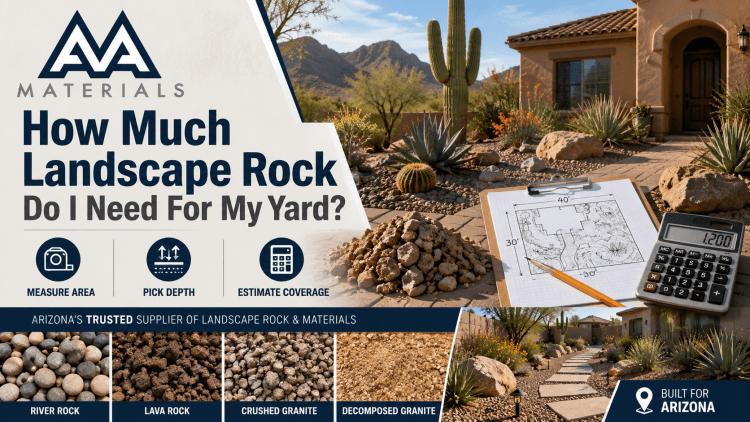
How Much Landscape Rock Do I Need For My Yard?
The empty patch beside the driveway does not look very large. Then the rock arrives, the pile disappears faster than expected, and several feet of bare ground remain.
Estimating landscape rock by sight is difficult. The area may be easy to picture, but depth changes the order more than many homeowners expect. A measurement taken before visiting the materials yard can prevent an extra delivery or a large pile left behind after the work is finished.
You only need a tape measure, a calculator, and a reasonable idea of how deep the rock should be.
Begin With The Shape Of The Area
A rectangular bed is straightforward. Multiply its length by its width to find the square footage.
Suppose the area measures 20 feet long and 30 feet wide. Multiplying those numbers gives you 600 square feet.
Circular and triangular spaces require different calculations. Irregular yards can usually be divided into several smaller shapes. Calculate each section separately, then add the results together.
Do not subtract every cactus, shrub, or small landscape feature. The amount saved is often too minor to justify the added measuring. A large patio, pool, or structure should be removed from the total.
Depth Changes Everything
Square footage only describes the surface. Rock is purchased by volume, so depth must be included.
For a two inch layer, convert two inches into feet by dividing it by 12. The result is approximately 0.167 feet.
Multiply the 600 square feet from the earlier example by 0.167. That gives you roughly 100 cubic feet. Divide that number by 27 to convert it into cubic yards. The estimated order is approximately 3.7 cubic yards.
That figure is a starting point rather than a promise. Ground conditions, rock size, settling, and the existing surface can alter the amount needed.
New Rock And Refreshing Old Rock Are Different Jobs
A bare landscape generally needs more material than a yard that already has rock. When refreshing an existing bed, the goal may be to restore color and cover thin areas rather than create a completely new layer.
Rake a few test spots before ordering. Dust and smaller particles may hide usable rock underneath. Other areas may have lost material because of foot traffic, drainage, or years of cleanup with a leaf blower.
Rock placed too thin may allow the old surface to show through. An excessively deep layer can spill over edging, cover irrigation components, or make walking uncomfortable.
Rock Type Affects The Order
A cubic yard measures volume, not weight. Different materials do not weigh exactly the same. River rock, cinders, riprap, and decorative gravel also settle differently because their shapes and sizes vary.
This is why converting cubic yards into tons without identifying the material can create a poor estimate. Choose the product first, then ask the supplier about its typical coverage and weight.
Natural stone can also vary in color and size. Visit the yard when appearance matters, especially when trying to blend new material into an older Scottsdale landscape.
Order Landscape Rock In Scottsdale
A&A Materials supplies decorative rock, river rock, cinders, boulders, sand, dirt, mulch, and construction aggregates. Coverage calculators are available for rectangular, circular, and triangular areas.
Call A&A Materials at 480 990 0557 for current product availability, quantity assistance, pickup, or delivery.
References
A&A Materials Coverage Calculators
https://aamaterialsinc.com/calculator2.shtml
A&A Materials Material List
https://aamaterialsinc.com/material.shtml
A&A Materials Decorative Rock
https://aamaterialsinc.com/decorative-rock.shtml
A&A Materials River Rock
https://aamaterialsinc.com/river-rock.shtml