
How Well Does Cinder Rock Work In Arizona Gardens?
Written by webtechs

How Well Does Cinder Rock Work In Arizona Gardens?

Cinder rock is one of those landscape materials that makes a lot of sense in Arizona once you understand what it does well. It has a bold, natural look, it holds up beautifully in dry weather, and it fits right in with desert style yards, cactus gardens, and low water landscapes.

It is not the perfect choice for every single planting bed, but used in the right place, cinder rock can be practical, attractive, and surprisingly easy to live with.

What Is Cinder Rock?

Cinder rock is a lightweight volcanic rock with a porous texture. You will often see it in red, black, brown, or darker earth tones, which makes it a good match for Arizona homes, desert plants, and natural stone features.

Because it is decorative and durable, many homeowners use cinder rock around succulents, agaves, cacti, walkways, dry creek beds, and open yard areas where they want a clean, finished look without constant maintenance.

Why Cinder Rock Works Well In Arizona

Arizona gardens have to deal with intense sun, dry air, limited rainfall, and long stretches of heat. Organic mulch can still be useful around certain plants, but it breaks down over time. Cinder rock does not decompose the same way wood mulch does, so it can last for years with very little attention.

It also helps reduce bare soil exposure. That matters because uncovered soil dries quickly and can blow around during windy days or monsoon storms. A layer of cinder rock can help keep beds neater, reduce erosion, and make the landscape look more intentional.

For desert plants that prefer excellent drainage and do not want soggy soil, cinder rock can be a strong fit.

Where Cinder Rock Really Shines

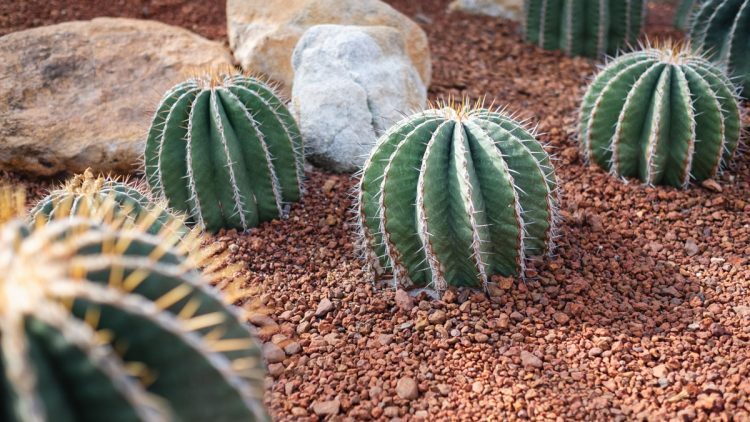
Cinder rock works especially well in xeriscapes and desert gardens. It looks natural around cactus, yucca, aloe, agave, ocotillo, and other drought tolerant plants. It also creates strong color contrast, especially when paired with green or silver foliage.

It can be used to define borders, cover large open areas, or add texture around boulders and gravel. In many Arizona yards, cinder rock gives the landscape a warmer and more custom look than plain dirt or basic gravel.

It is also useful in places where you want a decorative ground cover that will not need replacing every season.

A Few Things To Keep In Mind

Like most rock products, cinder rock can hold and reflect heat. In full sun, that can make the area around tender plants hotter. This is not usually a problem for tough desert plants, but it may be too harsh for delicate flowers, shallow rooted plants, or beds that already struggle in summer.

Cinder rock can also settle into soil over time if there is no barrier underneath it. A quality landscape fabric may help keep the rock cleaner and make future maintenance easier, especially in areas where weeds are a concern.

It is also worth choosing the right size. Smaller cinder rock can create a smoother look, while larger pieces give more texture and a rugged desert feel.

Is Cinder Rock Better Than Mulch?

It depends on the garden. Around desert plants, pathways, and low maintenance spaces, cinder rock can be a terrific choice. Around trees, shrubs, and plants that benefit from cooler, richer soil, organic mulch may be better.

Many Arizona landscapes use both. Cinder rock can handle the decorative, long lasting areas, while mulch can be used where plant health and soil improvement are the bigger priorities.

Build A Better Arizona Garden With The Right Material

Cinder rock works very well in Arizona gardens when it is matched to the right plants and the right design. It is durable, attractive, low maintenance, and naturally suited to many desert landscapes.

For cinder rock, decorative rock, sand, gravel, soil, and other landscape materials, contact A&A Materials today. Their team can help you choose the right product for your yard, garden, or outdoor project.

References

University of Arizona Cooperative Extension, Xeriscape: Landscaping With Style In The Arizona Desert
A&A Materials

A&A Materials, Inc. specializes in decorative rock landscape materials in Scottsdale and surrounding areas, that make your property look its best year-round. Call us at 480-990-0557 with any questions or for more information.

What is Lava Rock?
Written by webtechs

What is Lava Rock?

Do you ever look at your yard and think, “That space has more promise than I am taking advantage of.”

Think about your possibilities! You could create some orderly flower beds and winding pathways. A koi pond could be the perfect addition. Perhaps a waterfall. A couple more flowers and succulents.

So, what’s the problem?

Probably, the challenges stopping you are costs and maintenance. The notion of buying expensive materials and keeping your landscape features thriving and clean feels overpowering.

Luckily, it doesn’t have to be that way. Lava rock is landscaping rock that allows you to keep expenses down and maintenance minimized.

What is Lava Rock?

Lava rock is a porous type of rock with a lot of decorative and realistic uses, including landscaping.

Lava rock is technically referred to as “scoria.” It is an igneous rock and is formed out of volcanic gases mixing with magma prior to erupting from a volcano. When the lava cools prior to the gases escaping, it creates scoria or lava rock.

Those trapped gases create pores in the the rock for filtration and drainage. Also making this rock lighter in weight than other kinds of rock. Nevertheless, unlike pumice, a comparable lightweight rock, this rock does not have the ability to float.

Ideas for Utilizing Lava Rock in Landscaping

As mentioned above, one of the more favorable ways to utilize this type of rock is in your landscaping. Lava rock looks spectacular:

  • In flower boxes
  • On walkways
  • In water features

Lava rock for xeriscaping

Are you tired of trying to professionally maintain your backyard with all the irrigating, trimming, and mowing involved?

Conventional landscaping is not your only choice! You can attain gorgeous, low-maintenance outcomes by embracing xeriscaping.

Xeriscaping utilizes rocks and drought-resistant plants like cactus or other succulents for creating appealing backyard landscapes you’ll seldom or never be required to water, prune, or mow.

Lava rock can be used to create xeriscapes

To create a breathtaking xeriscape space, it’s vital to carefully decide on the correct plants and appropriate rock types.

This type of rock makes an attractive and appealing addition to the xeriscape due to its vibrant red or deeper black color.

It also generates a healthy, low-maintenance environment by retaining moisture in the soil and stopping weeds from growing.

Lava rock fire pit

One way for adding drama and visual appeal to your yard while creating an area to gather and socialize is to purchase or create a fire pit for your backyard. And this rock is the perfect material to use in your fire pit!

Besides looking beautiful, it just makes sense: these rocks come from volcanoes, so it’s only natural that they would stand up well and look astonishing underneath a dazzling fire.

Thisrock evenly disperses heat, offering a better overall fire pit experience. The rock helps the heat radiate outwards in a delightful, calming way, warming the body and mind.

Landscape Lava Rocks (cinders) Phoenix by A&A Materials, Inc.

A & A Materials, Inc., located in Scottsdale, Arizona, offers Lava Rock (cinders) for your landscaping needs. Call us at 480-990-0557 for more information.

How Well Does Cinder Rock Work In Arizona Gardens?
Written by webtechs

What is Cinder Rock?

This volcanic rock has been used for many years as a more conventional decorative stone. Black or cinder stands out in a planter or flower bed due to its dark complexion and rough, porous surface.

Use: Cinder, sometimes referred to as “lava rock,” is a fantastic material for landscaping. It can be applied to water feature accents, flower beds, and ornamental landscapes.

Although they are both volcanic landforms, cinder cones and lava domes have different formation, structure, and properties:

Dome of Lava

Formation: Viscous lava builds up close to the vent and slowly extrudes to form lava domes. This lava is more viscous than basaltic lava because it is usually andesitic, dacitic, or rhyolitic in composition.
Shape: They resemble domes and frequently have small bases and steep sides. As the lava cools and solidifies, the surface may become rough and fractured.
Lava domes are typically smaller than cinder cones, though they can vary in size. As more lava is extruded over time, they may enlarge.
Lava dome eruptions are typically less violent, but they can still result in pyroclastic flows in the event that the dome collapses or the lava becomes overly pressurized.

The Cinder Cone

Formation: The accumulation of volcanic debris, mostly tiny lava fragments known as cinders, which are released during violent eruptions, forms cinder cones. Around the vent, these pieces gradually return to the ground to form a hill in the shape of a cone.
Shape: They are conical and steep, and at the top is a bowl-shaped crater. The slopes can be fairly steep and are usually uniform.
Size: Cinder cones can grow to a height of several hundred meters and are typically larger than lava domes.
Style of Eruption: Cinder cone eruptions typically produce a large amount of ash and cinders and are explosive. Lava flows that might emanate from the base can also be produced by them.

In conclusion, cinder cones are constructed from the accumulation of ejected volcanic fragments and have a steep, conical shape, whereas lava domes are formed from the slow extrusion of viscous lava and have a dome-like shape. Lava domes are less explosive than cinder cone eruptions, which are usually more explosive. The eruption styles also vary.

A&A Materials, Inc. specializes in decorative rock landscape materials in Scottsdale and surrounding areas, that make your property look its best year-round. Call us at 480-990-0557 with any questions or for more information.